08
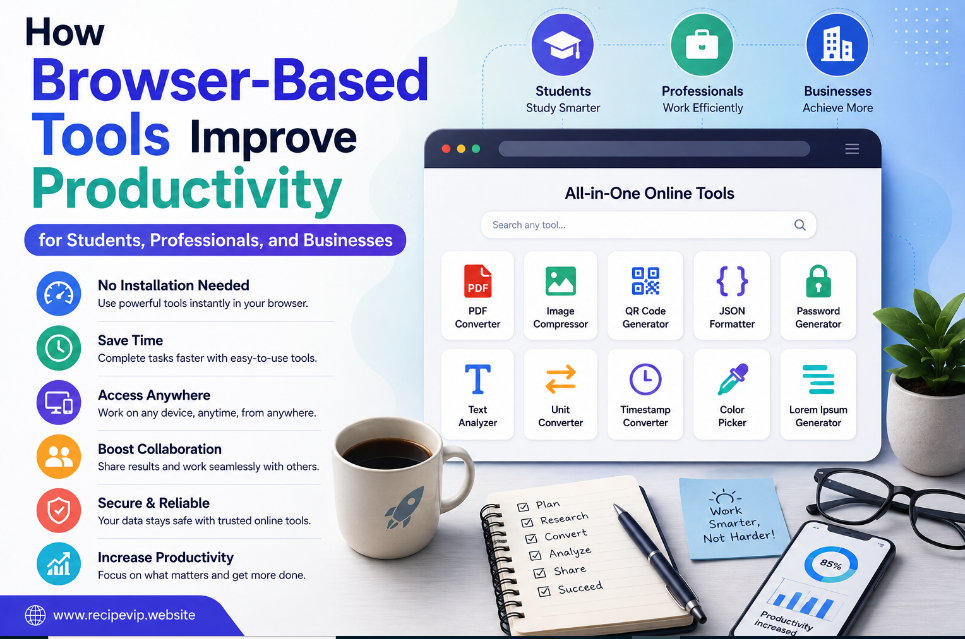
How Browser-Based Tools Improve Productivity for Students, Professionals, and Businesses
Discover how browser-based tools help students, professionals, developers, and businesses work faster, reduce repetitive tasks, and stay productive without installing traditional software.
Productivity isn't always about working harder. More often, it's about removing unnecessary steps that slow progress and interrupt concentration.
Modern technology offers countless ways to complete digital tasks, yet many people still lose valuable time switching between applications, installing software they only use once, or searching for solutions that should take only a few seconds.
Browser-based tools have changed that experience.
Instead of depending on large desktop programs for every small task, users can now perform hundreds of everyday operations directly from a web browser. From converting files and compressing images to checking website status or formatting code, online utilities have become reliable companions for millions of people around the world.
Their greatest advantage isn't simply convenience—it's efficiency.
Whether you're studying for an exam, managing a business, developing software, or creating digital content, browser-based tools help reduce repetitive work and allow you to focus on what truly matters.
Productivity Is About Eliminating Friction
When people think about productivity, they often imagine advanced planning systems, complicated software, or expensive subscriptions.
In reality, productivity frequently improves through much smaller changes.
Imagine spending five minutes downloading software every time you need to resize an image. Now imagine completing the same task in less than thirty seconds through your browser.
The time saved from one task may seem insignificant.
However, digital work consists of hundreds of small actions repeated every day.
Saving only a few minutes on each task quickly adds up to hours over weeks and months.
This is where browser-based tools create measurable improvements.
Instead of interrupting your workflow, they become a natural extension of it.
Why Browser-Based Tools Fit Modern Workflows
The way people work has changed dramatically over the last decade.
Employees work remotely.
Students attend online classes.
Freelancers collaborate with international clients.
Businesses operate across multiple devices and cloud platforms.
Because of these changes, flexibility has become more valuable than software that only exists on one computer.
A browser-based utility is available almost anywhere.
Whether you're using a desktop computer at work, a laptop at home, or a tablet while traveling, the same tool is often only a browser tab away.
This consistency allows users to continue working without worrying about installations, licenses, or operating system compatibility.
Helping Students Work More Efficiently
Students regularly perform repetitive digital tasks.
Assignments need word counts.
Research notes require formatting.
Presentations often include resized images.
Documents may need conversion before submission.
Instead of downloading specialized software for each requirement, browser-based tools provide quick solutions that help students spend more time learning and less time solving technical problems.
Simple utilities such as text formatting tools, file converters, image compressors, QR code generators, and word counters can make everyday academic work significantly easier.
More importantly, these tools remain accessible whether students are working from school computers, personal laptops, or shared devices.
Supporting Small Businesses
Small businesses often operate with limited budgets.
Purchasing professional software for every occasional task is rarely practical.
Browser-based utilities help reduce these costs by providing access to specialized functions whenever needed.
For example, a small business owner may need to:
- Resize product images.
- Compress graphics before uploading them.
- Generate secure passwords.
- Check website availability.
- Create QR codes for printed materials.
- Validate email addresses.
- Analyze redirects after updating website pages.
Instead of maintaining separate software for each activity, these tasks can often be completed using browser-based utilities within minutes.
The result is lower operational complexity without sacrificing productivity.
A Valuable Resource for Developers
Software developers frequently perform repetitive technical operations throughout the day.
Formatting JSON.
Converting timestamps.
Generating UUIDs.
Encoding Base64 strings.
Testing APIs.
Checking HTTP headers.
Inspecting redirects.
None of these tasks are individually difficult, but repeatedly opening desktop applications slows development.
Browser-based developer utilities simplify these routine operations while allowing programmers to remain focused on solving larger technical challenges.
Even experienced developers appreciate tools that eliminate unnecessary manual work.
Helping Content Creators Publish Faster
Content creators work with multiple types of digital assets.
Images.
Videos.
Documents.
HTML.
Markdown.
Metadata.
Preparing content for publication often involves many small adjustments before anything goes live.
Images need optimization.
Meta tags require verification.
Text formatting must remain consistent.
Files should remain compatible across platforms.
Online utilities simplify these preparation steps, allowing creators to spend more time producing quality content instead of managing repetitive technical details.
Improving Collaboration
Modern projects rarely involve only one person.
Teams share documents, exchange graphics, edit code, and collaborate across different operating systems.
Browser-based tools simplify this collaboration because everyone works with the same interface regardless of device.
Instead of asking whether a particular application is installed, team members simply open the same online utility and complete the task.
This consistency reduces compatibility issues while making collaboration smoother.
Accessibility Encourages Better Productivity
One overlooked advantage of browser-based utilities is accessibility.
Many online tools are designed with simple interfaces that reduce unnecessary complexity.
Buttons are clearly labeled.
Instructions remain concise.
Results appear immediately.
People with limited technical experience can often complete tasks successfully without extensive training.
Making technology easier to understand allows more people to work independently while reducing frustration.
Choosing the Right Tools Matters
Not every browser-based utility offers the same level of quality.
Reliable tools should provide accurate results, load quickly, protect user privacy, and avoid unnecessary distractions.
When selecting online utilities, users should consider:
- Secure HTTPS connections.
- Transparent privacy policies.
- Clear instructions.
- Fast performance.
- Minimal advertising interruptions.
- Consistent functionality.
Choosing trustworthy services improves both productivity and confidence.
Looking Ahead
Browser technology continues to evolve rapidly.
Tasks that once required expensive software are increasingly available through lightweight web applications.
Artificial intelligence, cloud computing, and faster internet connections will likely expand the capabilities of browser-based tools even further over the coming years.
However, despite technological advances, the primary goal will remain the same:
Helping people complete everyday work faster, more accurately, and with fewer unnecessary obstacles.
Conclusion
Productivity isn't measured by the number of applications installed on a computer. It's measured by how efficiently people can complete meaningful work.
Browser-based tools have become an important part of modern digital workflows because they remove friction from everyday tasks.
Whether you're a student preparing assignments, a developer writing code, a designer optimizing graphics, or a business owner managing a website, online utilities provide practical solutions that save time without adding unnecessary complexity.
As digital work continues to evolve, browser-based tools will remain an essential resource for anyone who values simplicity, flexibility, and efficiency.
Frequently Asked Questions
Are browser-based tools suitable for professional work?
Yes. Many professionals use browser-based utilities daily for file conversion, development, website maintenance, image optimization, and other routine tasks.
Do browser-based tools replace desktop software?
Not entirely. Professional desktop software remains important for complex projects, while browser-based tools excel at quick and specialized tasks.
Can students benefit from online utilities?
Absolutely. Students frequently use browser-based tools for formatting documents, converting files, organizing text, and preparing assignments.
Why are browser-based tools becoming more popular?
They require no installation, work across multiple devices, receive automatic updates, and simplify many everyday digital tasks.
What makes a good online utility?
A reliable online tool should be secure, easy to use, accurate, fast, and transparent about how user data is handled.
Contact
Missing something?
Feel free to request missing tools or give some feedback using our contact form.
Contact Us